The Real Spirit of the BBM
Introduction
The Bachelor of Business Management (BBM) program is designed to prepare students for a business environment that demands much more than theoretical knowledge. Modern managers are expected to think critically, communicate effectively, collaborate with others, solve problems, make decisions, demonstrate creativity, and respond confidently to changing business environments. Therefore, the real spirit of BBM lies not merely in completing a syllabus or passing examinations, but in developing future managers, entrepreneurs, innovators, and responsible business leaders.
Yet an important question deserves serious attention: Are some teaching practices unintentionally killing the real spirit of the BBM program?
The question is not intended to blame teachers. Teachers are central to the success of any academic program. Rather, it invites institutions and educators to examine whether classroom practices are aligned with the philosophy and objectives of management education.
The Problem of Teaching BBM Like a Conventional Academic Program
One of the major risks is treating BBM as another examination-oriented undergraduate program. When teaching becomes primarily focused on completing chapters, dictating notes, preparing students for examinations, and reproducing textbook definitions, students may obtain marks without necessarily developing managerial capabilities.
Business management cannot be learned effectively only by memorizing concepts. A future manager needs to understand why something happens, analyze alternatives, defend a position, work with people, and make decisions under uncertainty.
If a BBM classroom looks exactly like a traditional lecture classroom, it is worth asking whether students are receiving the experience that a management program is supposed to provide.
When the Teacher Becomes the Only Source of Knowledge
A strong BBM classroom should not depend entirely on the teacher speaking while students listen.
The teacher's role should increasingly move from being the sole provider of information to being a facilitator of learning. Students should be encouraged to investigate businesses, analyze real cases, conduct small research projects, debate business decisions, make presentations, and learn from one another.
For example, instead of simply explaining the concept of business environment, students could investigate why a particular Nepalese business succeeded, why another struggled, how government policy affected it, or how competition changed its strategy.
Such activities transform a classroom from a place of information delivery into a laboratory for managerial thinking.
The Missing Connection Between Theory and Nepalese Business
BBM students should be able to look at a Nepalese business and connect classroom theory with what they observe.
Nepal provides countless opportunities for such learning. Students can study banks, insurance companies, restaurants, manufacturing industries, technology companies, educational institutions, retail businesses, startups, family businesses, cooperatives, and social enterprises.
When students investigate actual organizations, concepts such as leadership, organizational behavior, marketing, entrepreneurship, business environment, human resource management, and strategic management become meaningful.
A management student should therefore frequently be asked:
"If you were the manager, what would you do?"
That question is often more educational than:
"Define this concept."
The 4C Skills Cannot Be Developed Through Lectures Alone
The modern BBM student needs Critical Thinking, Communication, Collaboration, and Creativity.
These skills cannot be developed simply by telling students about them.
Critical thinking requires students to question assumptions and evaluate alternatives.
Communication requires students to explain ideas clearly to others.
Collaboration requires students to work with people who may have different opinions.
Creativity requires students to develop solutions rather than merely reproduce existing answers.
Consequently, classroom presentations, case studies, group projects, business simulations, debates, field studies, entrepreneurial activities, and problem-solving exercises should complement conventional teaching.
When Teachers Discourage Questions
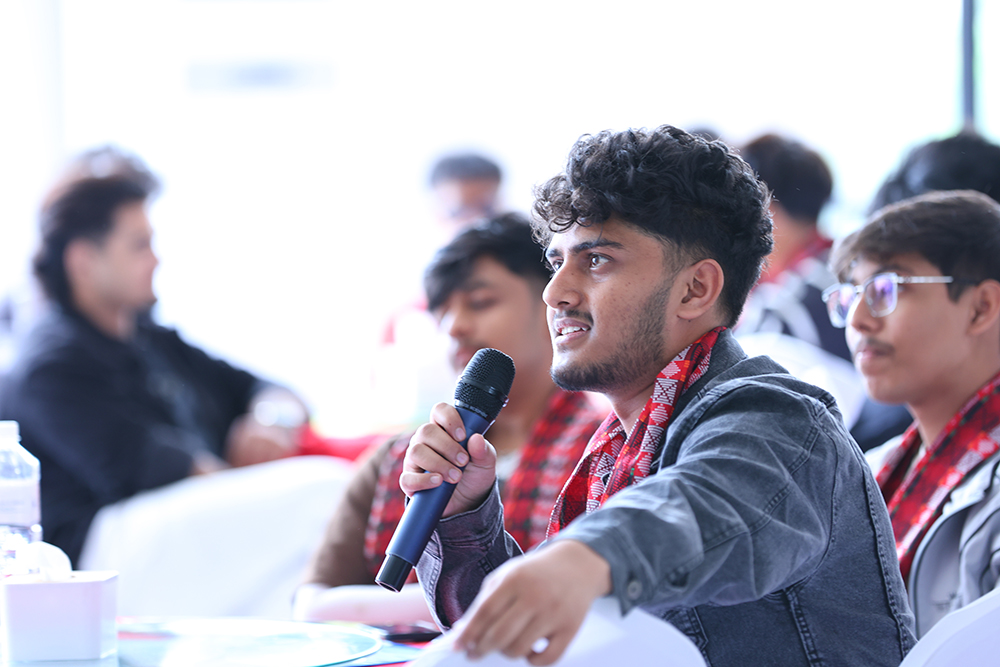
A particularly damaging classroom culture develops when students feel that questioning the teacher is disrespectful.
Management education should encourage intellectual curiosity.
A student who asks "Why?", "What if?", or "Is there another way?" is potentially demonstrating exactly the kind of thinking that business education should cultivate.
Teachers do not need to have every answer. In fact, telling students, "I don't know; let's investigate it together" can sometimes demonstrate more authentic learning than providing an immediate answer.
The objective should not be to create students who can repeat everything their teachers say. It should be to create graduates who can think independently.
The Danger of Teacher Gossip and Unproductive Classroom Culture
Professionalism is also part of management education.
Teachers are role models. Students observe not only what teachers teach but also how they behave.
If valuable academic time is consumed by unnecessary gossip, personal conversations, excessive use of phones, or unrelated activities, students receive an unintended lesson about workplace behaviour.
A management classroom should model the professional environment that students are expected to enter.
Teachers should demonstrate:
-
punctuality;
-
preparedness;
-
professional communication;
-
respect for colleagues and students;
-
effective time management;
-
constructive feedback;
-
ethical behavior; and
-
commitment to continuous learning.
Students learn professionalism partly by observing professionals.
The Examination Trap
Examinations are necessary, but they should not become the destination of BBM education.
If students are repeatedly rewarded for memorizing model answers, they may naturally optimize their behaviour around examinations.
The result can be a paradox: students may score well but hesitate when confronted with an unfamiliar business problem.
A stronger assessment approach would combine examinations with:
-
case analysis;
-
presentations;
-
group projects;
-
business research;
-
field assignments;
-
reflective reports;
-
problem-solving exercises; and
-
practical business projects.
Assessment should measure not only what students know, but also what they can do with what they know.
Teachers Are Not the Enemy
It is important to avoid turning this discussion into an accusation against teachers.
Many teachers work extremely hard and contribute significantly to students' academic and personal development. The issue is broader than individual performance.
Teachers themselves may operate within institutional systems that emphasize syllabus completion, examination results, administrative requirements, limited resources, large classes, and conventional assessment practices.
Therefore, improving BBM education requires an institutional commitment as well.
College leadership, program coordinators, faculty members, and students need to collectively ask:
Are our teaching methods producing graduates who can actually manage?
What Should a BBM Classroom Look Like?
A vibrant BBM classroom could include a combination of:
20% Concept + 30% Discussion + 30% Application + 20% Reflection
The exact percentages are not important. The principle is.
Students should encounter a concept, discuss it, apply it to a real situation, and reflect on what they learned.
For example, a lesson on entrepreneurship could begin with a Nepalese business case. Students could identify the entrepreneur's problem, work in groups to develop alternative solutions, present their recommendations, challenge one another's assumptions, and finally connect their findings with entrepreneurship theory.
Now the classroom becomes an experience rather than merely a lecture.
From "Teaching the Syllabus" to "Developing Managers"
Perhaps the most important shift is conceptual.
Teachers should not ask only:
"Have I completed my chapter?"
They should also ask:
"What capability has the student developed today?"
Did students learn to analyze?
Did they communicate?
Did they collaborate?
Did they solve a problem?
Did they make a decision?
Did they question an assumption?
Did they develop a new idea?
Did they connect theory with the real business world?
These questions capture the real spirit of management education.
Conclusion
The real spirit of BBM is unlikely to disappear because of one teacher, one lecture, or one examination. It is threatened when an entire educational culture gradually reduces management education to notes, lectures, attendance, assignments, and examinations.
Teachers have the power to reverse that trend.
A BBM classroom should be energetic, questioning, practical, collaborative, and connected to the real business environment. Students should not merely learn about management; they should experience the process of thinking and acting like managers.
The ultimate measure of a BBM program should therefore not be simply whether students can reproduce what they were taught.
It should be whether, after graduation, they can walk into an unfamiliar business situation and confidently say:
"I don't have all the answers—but I know how to analyze the problem, work with people, explore alternatives, and make a decision."
That is the spirit of BBM. And protecting that spirit is a shared responsibility of teachers, institutions, and students.